Progress Billing for Hardscape and Install Jobs
A hardscape job billed only at the end turns the contractor into the bank. Name three triggers on the quote. The due date is a separate decision.
By Verdis4 min read
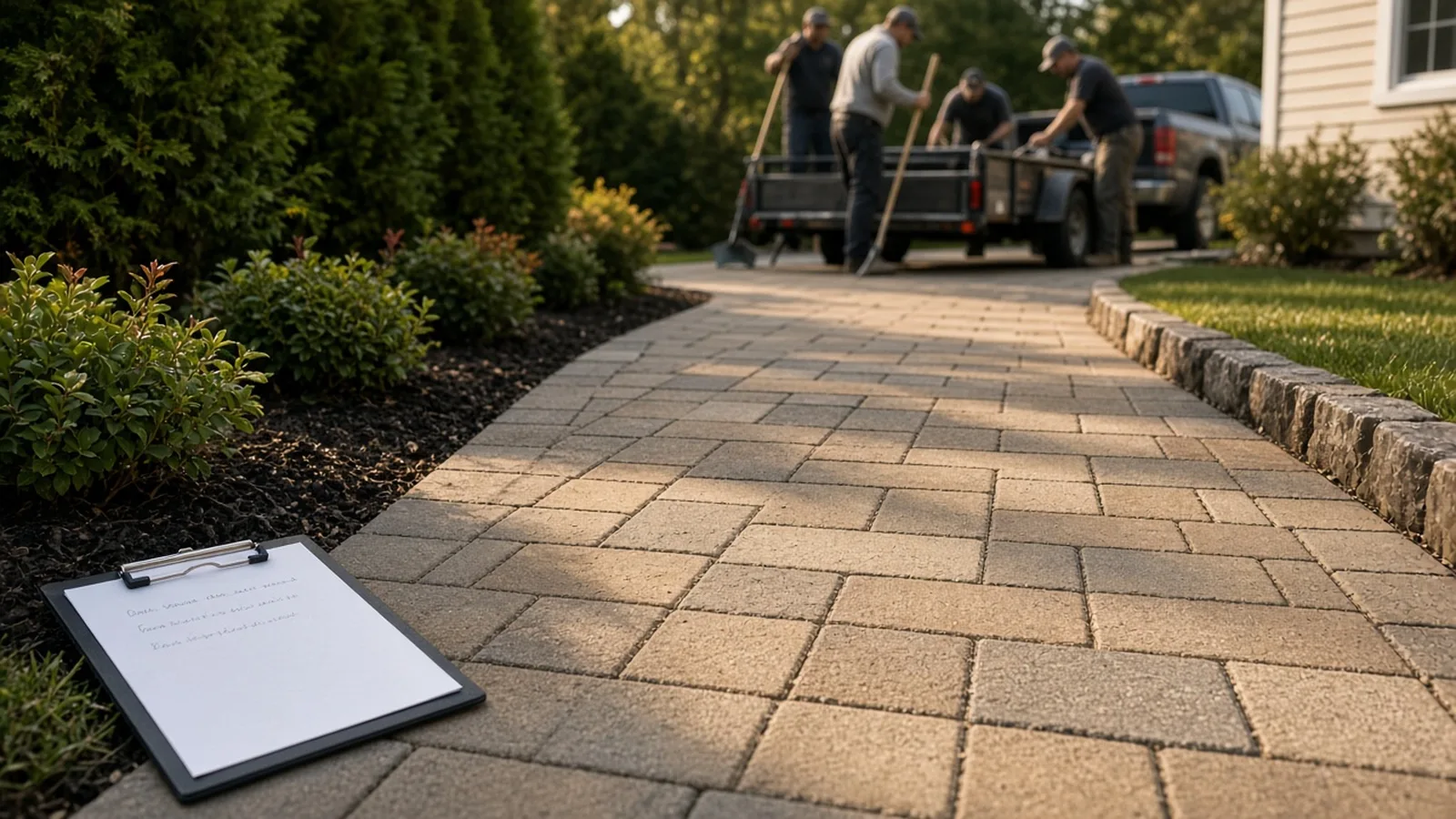
A walkway can be finished and accepted while the paver bill has been yours for weeks. That gap is what progress billing is for. It is not a cleverer due date. Net 15, net 30, and due on receipt belong to the invoice-terms decision, and that decision already has its own guide. This page is about when money should move on a hardscape or install job so you are not the bank.
Choose landscaping invoice terms by job type
Why the last day is the wrong only day
A maintenance route can often bill after the month. The cost of one visit is labor and fuel you were going to spend on the route anyway. A patio, a wall, a planting install, or a drainage job spends money before the last day. Materials get ordered. A dumpster arrives. A plate compactor is rented. A crew is on that job instead of on another one. If the only invoice goes out when the last stone is set, you funded the project.
Owners call this a cash-flow problem. It is also a scope problem. A client who has paid nothing has little reason to stop adding work while you are there. A client who has paid for a named stage can see what that payment bought.
Three triggers a client can see
Write the triggers on the quote before you order anything. Three is enough for most installs. Use a stage the client can look at. About halfway is not a stage. A base that is in and accepted is a stage. A walk-through that is signed is a stage.
First, before materials are ordered, send a deposit invoice. Do not order, and do not start, until it is paid. The deposit covers materials and the slot on the calendar. It is not a tip, and it is not a percent you copied from another contractor's job.
Second, when a stage you named is done and the client has seen it, send a progress invoice. The next stage waits until that invoice is paid, unless you wrote a different rule and you can afford to carry the cost. If you cannot point at the stage, you are not ready to invoice it.
Third, when the walk-through is signed, send the balance, due on receipt. A punch-list item you agreed to fix does not reopen the whole job as free credit. Fix a defect that is yours. Do not let a preference change become a reason to hold the last invoice.
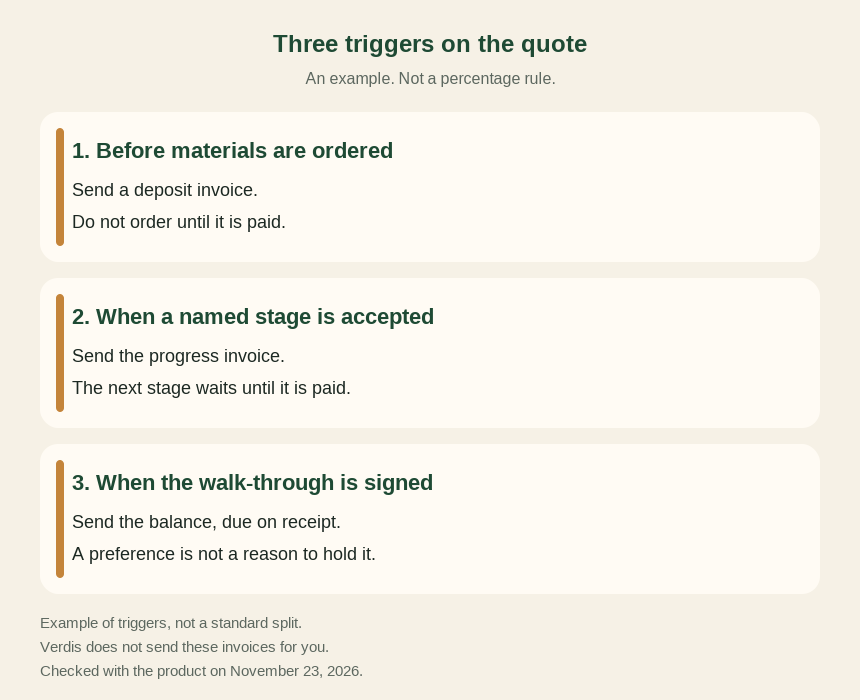
The graphic is an example of those three decisions. It is not an industry split. If your supplier wants the money before your client does, the first trigger has to land before the supplier's bill, not after it. Replace the stage names with the stages on the job in front of you.
Put the same trigger in three places
The quote names the trigger and what done means. The agreement the client accepts repeats it. Each invoice names the trigger it belongs to, so a progress invoice does not arrive as a surprise. If the invoice has no calendar date, you are back to the due-date problem: an invoice with no date is a favor. Pick the date in the invoice-terms guide, then keep that date on the quote, the agreement, and the invoice.
The objections, and a plain answer
I pay when it is finished
Answer with the materials you would otherwise own and the crew you cannot send somewhere else. Show the three triggers in writing. Do not cut the deposit to win the argument. A deposit that still arrives before you order is a sequence. A deposit you waive is a loan.
I need to see more
Then the stage is not accepted yet. Do not invoice a stage you cannot point at. Finish the thing you named, let them see it, and send the invoice then. Do not rename an unfinished stage so the invoice can go out today.
Can you roll it into the final invoice
That is the request to become the bank. You can say no. If you say yes on one job, write the exception on that job. Do not let it become the way every patio is billed.
What Verdis does, and what it does not
Verdis keeps the quote, the job, and the invoice on the same customer. When a client accepts a one-time quote, Verdis can create a job and a draft invoice from it. You still review the draft. Sending is a separate step. You choose Send by Email or Send by Text when you are ready. Draft, sent, paid, and overdue filters show which invoices need a next action. Completing a job does not send an invoice and does not charge a card.
Service plans are a different path, for repeating work. On Growth and Canopy you select eligible completed visits in Billing, review the lines, and create a draft. Sending that draft is still your decision. Seed includes quotes, one-time jobs, and invoices. Recurring service plans are not on Seed.
None of that writes the three triggers for you. Verdis does not send a progress invoice because a stage was checked off. The schedule lives on the quote you wrote. The software sends only what you send. The QuickBooks Online connection is a pilot. You can connect a company and preview invoices. Automatic sync is not live, so this schedule is not a bookkeeping export.
Hardscape jobs, from the quote to the invoice
Price the job before you set the triggers
Use the estimate calculator to get to a number you are willing to stage. Then write the triggers against that job. The calculator does not know your supplier's terms. You do.