Colorado Caps Summer Gas Equipment for Commercial Crews
Colorado approved a summer cap on gas-powered commercial lawn equipment, with a timeline from 2027 to 2032. The map and the equipment list are narrower than a statewide ban.
By Verdis3 min read
Colorado's Air Quality Control Commission approved a summer limit on gas-powered lawn and garden equipment used by commercial operators. The Colorado Department of Public Health and Environment announced it on November 20, 2026. This note is November 23. It follows the press release. Nobody from Verdis attended the hearing, and this is not a legal opinion.
Read the CDPHE announcement (opens in a new tab)
The timeline is the story
The revised Regulation 29 limits how much of an operator's covered equipment can still be gas-powered between June 1 and August 31. The release gives the allowed gas share as 85 percent in 2027, 65 percent in 2028, 40 percent in 2029, 25 percent in 2030, 15 percent in 2031, and 10 percent in 2032. The chart is that timeline and nothing else.
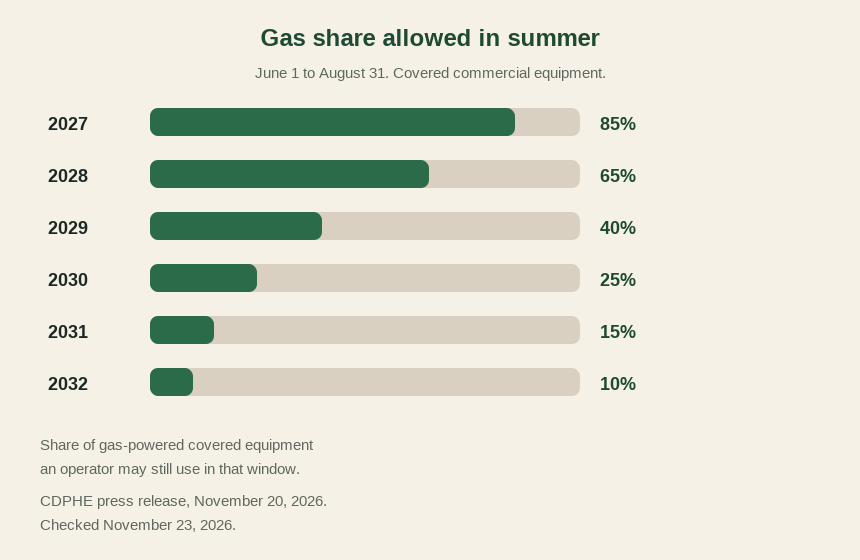
The first limit in the published timeline is the summer of 2027. The release does not describe fines, and this note will not invent them. The cap is a share of covered equipment during those three months. It is not a statement that every gas tool is illegal on the first of January.
Who, and which tools
The rule applies to commercial lawn and garden operators in ozone nonattainment areas. The release says those areas are mostly the Denver metro and parts of Weld County. The press release does not draw the parcel map. If you work near the edge, confirm the boundary from the commission's rulemaking materials. Do not plan a fleet from the word mostly.
People who do their own yard work are not expected to comply. A homeowner with a gas mower is outside this rule. A company paid to mow that yard is the operator the rule is written for.
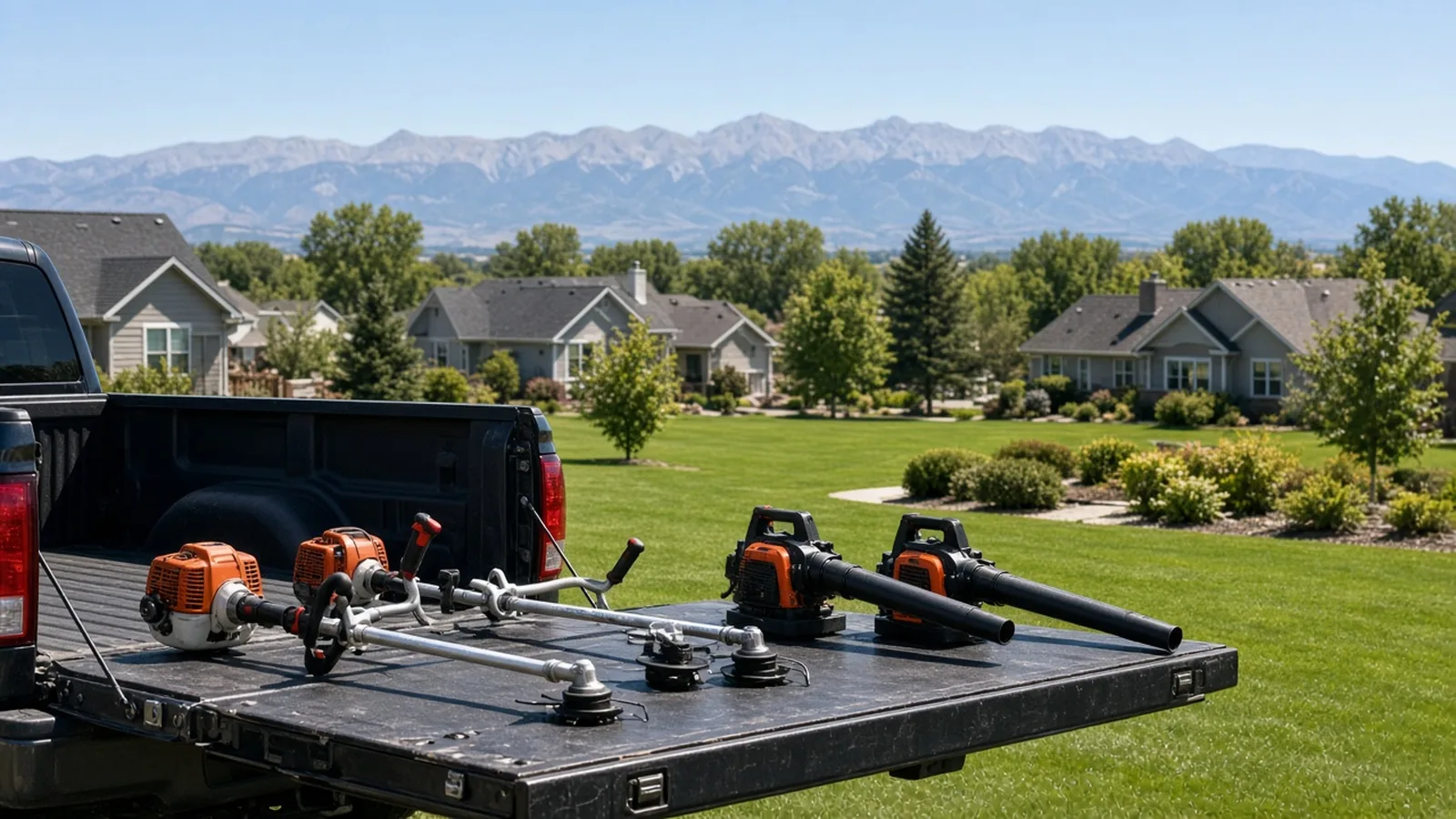
The equipment the release names is specific: gasoline-powered push and hand-held string trimmers, hedge trimmers, blowers, edgers, pole saws, and push or walk-behind mowers. The same release does not name riding mowers or trucks. Silence in a press release is not a permanent exemption. It is the list that was published on November 20. Read the rule text before you decide a machine is in or out.
The figures the division attached
The Air Pollution Control Division's modeling puts the lawn and garden sector at about 13 percent of ground-level ozone in the nonattainment area. The division estimates that after the requirements take full effect in 2032, Colorado could see as much as 166,000 fewer tons of greenhouse gases a year. The state has also extended a tax credit so qualified Colorado retailers can sell new electric-powered lawn equipment at a 30 percent discount, funded through January 1, 2030. Commercial operators may also be eligible for incentives or grants through the Regional Air Quality Council. The release does not price the equipment, the amount an operator pays at the register, or the cost of complying.
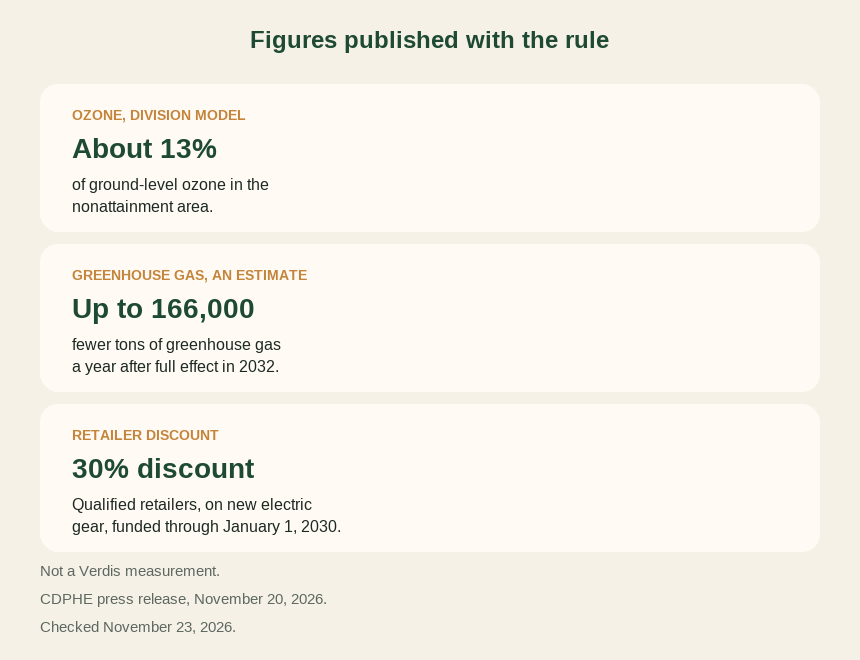
The ozone share and the greenhouse-gas figure are the division's. The second is an upper estimate in the release. They are not measurements made for this article. The 30 percent figure is a retailer discount in the same release. It is not a promise that a crew's own invoices fall by that amount.
What to do with this if you are outside the map
This is one state's rule for one season and one list of tools. It is not a national ban. Operators in the named areas can use the timeline to plan purchases before the summer of 2027, and they can ask the division the questions the release invites. The address published for air-quality comments is cdphe.commentsapcd@state.co.us.
Operators outside those areas should not rewrite a fleet plan from this summary. They can treat it as a preview of the kind of rule another ozone area can write, and they can write down the gas equipment they own before someone asks. A season closeout is a reasonable place to make that list. The release also points readers to the commission's rulemaking folder and the division's own page. Those pages, not this note, are the place to confirm a boundary, a machine, or a date.